



Introduction
In high-pressure oil and gas pipelines, refinery manifolds, and custody transfer stations, reliable fluid isolation sits at the heart of daily plant safety and environmental compliance. When a line needs maintenance, a pressure transmitter needs calibration, or different products share a manifold, standard valve isolation just isn’t enough. Operators need a Double Block and Bleed (DBB) system instead.
In the past, getting a true DBB state meant installing two separate block valves with a smaller bleed valve piped between them — a bulky, heavy, expensive setup. Today, advanced through-conduit slab gate valves offer full, certified DBB isolation in a single valve body. This guide breaks down how slab gate valves work internally, explains why they outperform traditional wedge gates for isolation, and covers how to specify them for tough pipeline service.
Technical Anatomy: What Makes a Slab Gate Valve a True DBB System?
According to API 6D, a Double Block and Bleed valve is a single valve with two seating surfaces that, when closed, seals against pressure from both ends while providing a way to vent or bleed the cavity between the seats.
A through-conduit slab gate valve achieves this through a distinct mechanical setup:
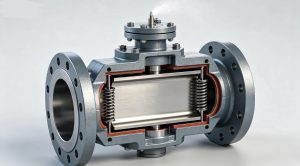
The Flat Slab Gate: Unlike a wedge-shaped disk, the gate here is a single, flat metal slab with a solid blocking section and a circular hole — the conduit. When open, this hole lines up with the pipe, creating a wide-open, seamless flow path. When closed, the solid part of the slab blocks the line completely.
Floating, Spring-Loaded Floating Seats: The seal doesn’t rely on mechanical wedging. Instead, the valve uses two independent, floating seat rings — one upstream, one downstream. These are backed by heavy-duty metallic springs that continuously press the seat inserts flat against the slab gate.
The Double-Sealing Mechanism: When you close the valve, upstream line pressure pushes the upstream floating seat firmly against the gate, creating the first mechanical block. At the same time, process fluid slips past that first layer and pushes the gate itself against the downstream floating seat, forming a second, independent block.
The Bleed System: With both seats sealed independently, the internal body cavity becomes fully isolated from both upstream and downstream pipeline pressure. Opening a dedicated needle or ball bleed valve attached to the body cavity vents this internal space, letting technicians confirm true isolation before any downstream maintenance.
Why Slab Gate Valves Beat Traditional Wedge Gate Valves in DBB Applications
Traditional wedge gate valves work well for general utility isolation, but they struggle to deliver true, certified DBB performance because of how they’re built.
The Problem with Wedge Gates in DBB Loops
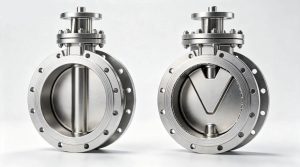
Wedge gate valves rely entirely on mechanical wedging force. The stem jams a tapered wedge down into a V-shaped pocket in the body, and since you need to jam it tightly to get a seal, these valves require a lot of torque to open and close.
On top of that, a standard flexible wedge valve usually only seals reliably on the downstream side, where line pressure pushes it — it rarely creates an independent, reliable upstream seal at the same time. Worse, if dirt, sand, or scale settles into the bottom V-shaped pocket, the wedge can’t travel deep enough to seat properly. That causes cavity bypass, making it hard to get a safe block-and-bleed state at all.
The Slab Gate Advantage
Slab gate valves use a parallel design that avoids this wedging force entirely. Since the floating seats are spring-loaded, they wipe the gate face clean every time the valve strokes, which stops solids from building up on the sealing faces.
The bottom of the body cavity is also completely flat, with no V-shaped pockets, so sediment passes straight through the conduit bore instead of getting trapped. That means the valve can maintain independent, simultaneous upstream and downstream sealing across thousands of cycles, even in dirty or sandy lines.
Crucial Engineering Benefits of DBB-Capable Slab Gate Valves
Using through-conduit slab gate valves in your manifold or pipeline brings some real operational advantages:
Space and Weight Optimization: Replacing a three-valve isolation manifold — two block valves, one bleed valve, and the associated spool piping — with a single DBB slab gate valve cuts structural footprint and piping weight by up to 60%. That matters a lot for weight-sensitive offshore platforms and compact pipeline skids.
Minimal Pressure Drop and Zero Turbulence: In the fully open position, the through-conduit bore lines up exactly with the pipeline’s internal diameter, so the permanent pressure drop is close to zero. The smooth bore also cuts down fluid turbulence, protects downstream equipment, and lets pipeline inspection pigs pass through freely.
Automatic Cavity Pressure Relief: Liquid hydrocarbons expand a lot when trapped in a closed valve cavity exposed to sun or process heat. If that trapped pressure climbs above the downstream line pressure, the spring-loaded floating seats get gently pushed away from the gate face. This automatically bleeds the excess pressure back into the pipeline, preventing a catastrophic body burst.
Comparative Evaluation: Slab Gate Valves vs. Wedge Gate Valves
| Performance Criterion | Through-Conduit Slab Gate Valve | Traditional Wedge Gate Valve |
| API 6D Certified DBB Action | Inherent (dual independent floating seats) | Rare (typically needs a double-disk configuration) |
| Sealing Principle | Fluid pressure + spring-assisted parallel seal | Mechanical wedging force (high stem torque) |
| Debris & Sediment Tolerance | High (self-wiping seats, flat bottom cavity) | Low (debris traps in bottom V-notch) |
| Pressure Drop (Cv Rating) | Minimal (equivalent to a straight pipe run) | Low (minor turbulence from seat recess) |
| Bi-Directional Sealing | Inherent | Dependent on wedge flexibility and alignment |
| Pigging Capability | Yes (full through-conduit design) | No (internal cavities obstruct pig passage) |
Material and Specifying Guide for Harsh Pipeline Environments
To make sure your slab gate valves deliver reliable DBB performance, the wetted material selection needs to match the process media:
Body and Bonnet Selections: For standard hydrocarbon pipelines, ASTM A216 WCB or A350 LF2 (low-temperature carbon steel) offers solid structural performance. For sour gas service with high hydrogen sulfide (H2S) content, the metallurgy has to follow NACE MR0175/ISO 15156 guidelines to prevent sulfide stress cracking.
Seat Ring Inserts (Soft vs. Hard Sealing):
Soft Seats: For clean natural gas and light refined products, soft seat inserts like PTFE, Devlon, or PEEK give a bubble-tight, zero-leakage seal.
Metal-to-Metal Seats: For crude oil with abrasive sand, heavy slurries, or high temperatures, you’ll want rugged metal-to-metal seating. In these cases, the gate and seat faces should be treated with High-Velocity Oxygen Fuel (HVOF) coatings — Stellite or Tungsten Carbide, for example — to prevent galling and erosive wear.
Stem Seal Integrity: Multi-layered chevron-style graphite packing combined with lip seals delivers zero-emission performance around the rising stem, protecting the external atmospheric boundary.
Why Choose Sedelon API 6D Slab Gate Valves?

For single-valve DBB isolation loops, precision engineering and strict quality control matter a great deal. Sedelon offers field-proven through-conduit slab gate valves designed for demanding industrial processes.
Full API 6D Monogrammed Certification: Every Sedelon slab gate valve is engineered, manufactured, and monogram-stamped in line with API 6D pipeline requirements, guaranteeing certified double block and bleed integrity.
HVOF Carbide Coating Expertise: For severe-service pipelines, our internal coating facilities apply ultra-flat, high-density Tungsten Carbide cladding to the gate and seat faces, giving an exceptionally hard surface (>60 HRC) that sheds particulates without losing seal tracking.
Advanced Fire-Safe Sealing Architecture: Our valves include secondary metal-to-metal backup seals that engage automatically if fire destroys the primary soft inserts. Certified to API 6FA and API 607, Sedelon valves hold their isolation integrity even under extreme thermal stress.
FAQs
1: What is the technical difference between a Double Block and Bleed (DBB) valve and a Double Isolation and Bleed (DIB) valve?
Under API 6D, a DBB valve has seats that seal against pressure from outside the valve — if the body cavity overpressures, the seats lift to relieve pressure back into the line. A DIB valve has seats that provide a bi-directional seal, blocking pressure from both the line and the cavity. That means DIB valves need an external safety relief valve to vent the body cavity during thermal expansion.
2: Can a slab gate valve be mounted horizontally or upside down?
The ideal setup is stem vertical, line horizontal. Mounting the valve fully upside down isn’t recommended, since heavy line debris can settle into the bonnet area over time and speed up stem packing wear. For horizontal stem orientations, it’s best to consult Sedelon engineering to confirm proper actuator support.
3: Is it necessary to operate a slab gate valve in a partially open position to throttle flow?
No, not at all. Slab gate valves are strictly on-off isolation devices. Operating one in a partially open position exposes the parallel sealing faces to high-velocity fluid impingement, which causes rapid erosion, cavitation, and permanent damage to the sealing surfaces.
4: How does the “self-wiping” action of the floating seats work?
Since the floating seats are pre-loaded by internal springs, they stay in continuous, flat contact with the slab gate face throughout the stroke. As the gate slides up or down, the sharp outer edge of the seat scrapes away paraffin wax, asphalt, or scale before it can get between the sealing surfaces.
5: What indicates that a slab gate valve has failed its DBB check?
Close the valve fully and open the body cavity bleed valve. Once the initial trapped fluid drains out, if fluid keeps flowing or spraying from the bleed valve, that means either the upstream or downstream seat has been damaged and is passing process media.
6: Why are slab gate valves preferred over ball valves for large-diameter pipeline isolation?
Ball valves are great for quarter-turn actuation, but in very large sizes — above 24 inches, say — the weight of a solid ball increases seat friction and operating torque significantly. Large slab gate valves distribute fluid pressure loading more evenly across their parallel tracks, which often makes for a more cost-effective, lighter assembly at big pipeline diameters.
Conclusion
Upgrading your pipeline isolation loops to true Double Block and Bleed systems is a big win for both safety and efficiency. Traditional wedge gates still have a place in basic on-off utilities, but their reliance on mechanical wedging and their tendency to trap dirt make them a poor fit for high-performance DBB isolation.
Through-conduit slab gate valves remove wedging stress, stop solids from getting trapped, and offer a full-bore, piggable path with virtually zero pressure drop. Stick to clear API 6D standards, specify tough carbide coatings for harsh lines, and partner with an experienced valve manufacturer like Sedelon — and you can optimize your manifolds, shrink your footprint, and count on dependable block-and-bleed performance for the long haul.