



In any fluid handling system—pipeline, pump station, or processing plant—protecting downstream equipment from debris is essential. A strainer is a mechanical device that removes solid particles from liquid or gas streams using a perforated or mesh element. It acts as the system’s first line of defense, preventing damage to pumps, valves, meters, and other sensitive components. At Sedelon Valve, we manufacture high-quality industrial strainers for applications ranging from water treatment to petrochemical processing. Explore our range at Our Web.
Common Strainer Types and Their Characteristics
The table below compares the most widely used strainer designs. Understanding these differences helps select the right strainer for your application.
| Type | Configuration | Cleaning Method | Typical Applications | Pressure Rating |
|---|---|---|---|---|
| Y‑Type Strainer | Compact, Y‑shaped body with angled screen | Manual (blow‑down valve or screen removal) | Steam, gas, high‑pressure lines, small piping | Up to Class 2500 |
| Basket Strainer | Larger housing with removable basket | Manual (basket removal and cleaning) | Liquid lines, high‑flow systems, cooling water | Up to Class 600 |
| T‑Type Strainer | Straight‑through body with perpendicular screen | Manual or duplex (dual chambers) | General liquid and gas service | Up to Class 900 |
| Duplex Strainer | Two parallel baskets with diverting valves | Continuous (switch to one side while cleaning the other) | Critical processes where shutdown is not permitted | Up to Class 600 |
| Automatic (Self‑Cleaning) | Mechanically or electrically cleaned screen | Continuous (backwash or scraper) | Large water systems, wastewater, high‑debris loads | Up to Class 300 |
What Exactly Is a Strainer?
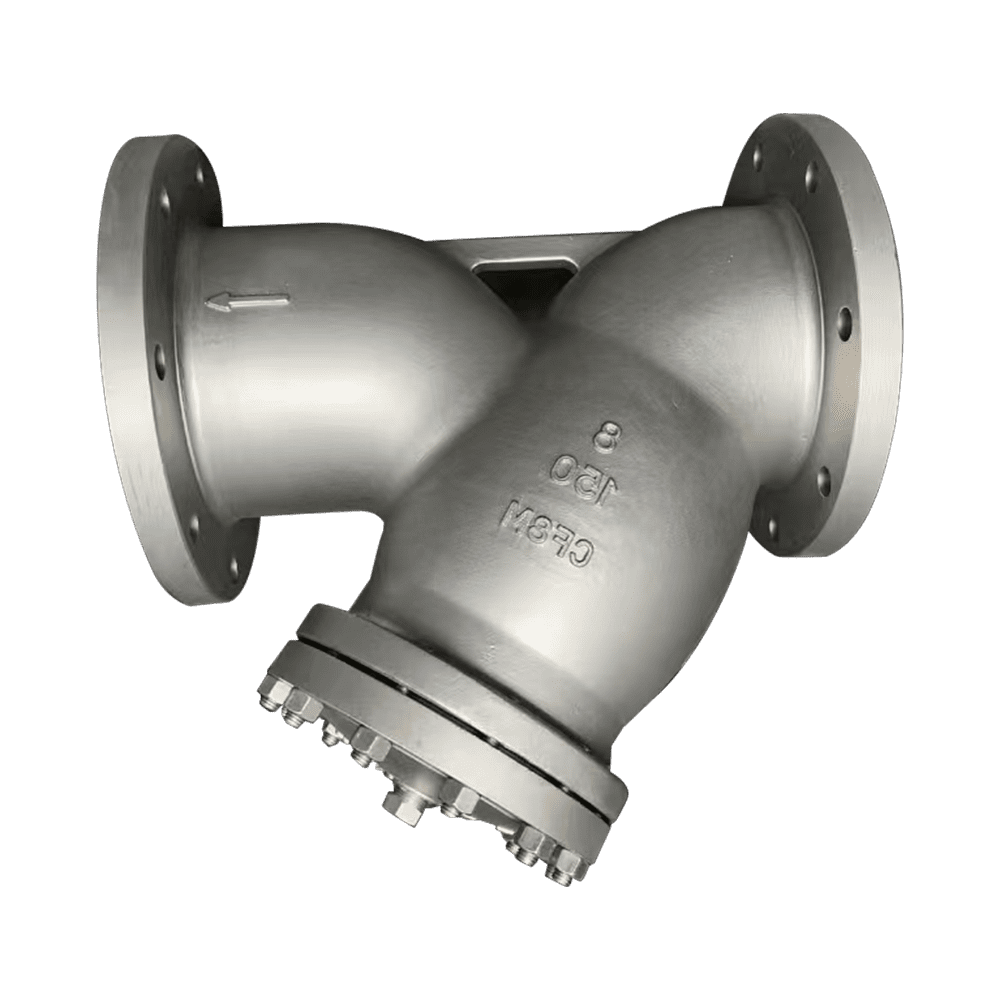
A strainer is a mechanical filter installed in pipelines to remove solids—rust, scale, weld slag, sand, or other particulates—from flowing fluids. Unlike filters that capture microscopic particles, strainers typically target particles ranging from 0.5 mm to several millimeters, depending on the mesh size. The device consists of a body (housing), a screen or perforated element, and a cover (or blow‑down connection) for cleaning.
Strainers are classified by their connection type (flanged, threaded, or butt weld), pressure rating(ASME Class 150 to 2500), and screen perforation (mesh size or hole diameter). They are installed upstream of pumps, control valves, flow meters, and other sensitive equipment to prevent damage from debris—a role often described as “the insurance policy of the piping system.”
How Does a Strainer Work?
The operating principle is simple but effective:
-
Flow entry: Fluid enters the strainer body through the inlet port.
-
Debris capture: The fluid passes through a screen or perforated basket. Solids larger than the screen openings are trapped on the upstream side of the screen.
-
Clean fluid exit: The filtered fluid continues through the outlet port to downstream components.
-
Debris removal: Accumulated solids are periodically removed by opening a blow‑down valve (for Y‑type) or removing the screen/basket (for basket or duplex designs).
The mesh size determines the smallest particle captured. Common mesh sizes range from 20 mesh (0.85 mm openings) for coarse straining to 200 mesh (0.074 mm) for fine straining. For applications requiring very fine filtration, filters with cartridge elements are used instead.
Key Components of a Strainer
A well‑designed strainer comprises several critical components:
-
Body: The pressure‑containing housing, typically cast carbon steel, stainless steel, or bronze. Must meet ASME pressure‑temperature ratings.
-
Screen or basket: The filtering element, usually made of perforated metal or woven wire mesh. Perforated screens (1–6 mm holes) handle coarse debris; mesh screens (20–200 mesh) capture finer particles.
-
Cover / cap: Removable access for cleaning. Gasketed or bolted to the body.
-
Blow‑down connection (Y‑type): A small valve that allows flushing accumulated debris without removing the screen.
-
Drain plug: For draining fluid before maintenance.
In duplex strainers, a three‑way or four‑way diverting valve allows flow to be switched between two baskets, enabling continuous operation while one basket is cleaned.
Y‑Type Strainers: Compact and Versatile
The Y‑type strainer takes its name from its shape: the screen is housed in an angled branch that resembles the letter “Y.” This design offers several advantages:
-
Compact footprint: Fits in tight spaces where basket strainers cannot.
-
High‑pressure capability: Suitable for steam, high‑pressure gas, and liquid lines up to Class 2500.
-
Easy cleaning: A blow‑down valve on the strainer cap allows flushing without removing the screen.
Y‑type strainers are typically installed with the screen element pointing downward to allow solids to collect away from the main flow path. They are the standard choice for steam systems, compressor suction lines, and high‑pressure applications where space is limited.
Basket Strainers: High‑Capacity and Easy Maintenance
Basket strainers feature a larger housing that contains a removable perforated basket. Key characteristics:
-
High flow capacity: Suitable for pipelines from 2″ to 24″ and larger.
-
Low pressure drop: Large basket surface area minimizes flow restriction.
-
Easy cleaning: The basket is removed, cleaned, and reinstalled without disturbing piping.
Basket strainers are available in simplex (single basket) or duplex (dual basket) configurations. They are common in cooling water systems, pump suction lines, and industrial liquid processes where debris loads are moderate to heavy.
Duplex Strainers: Continuous Operation
For critical processes where shutdown is not possible, duplex strainers provide uninterrupted service. Two baskets are mounted in parallel with a diverting valve that allows flow through one side while the other side is cleaned. Operation:
-
Flow is directed through one basket.
-
When debris accumulates, the diverting valve is switched to the second basket.
-
The first basket is isolated, depressurized, and cleaned.
-
The process repeats without system shutdown.
Duplex strainers are essential in continuous manufacturing, power plants, and offshore facilities where even brief downtime results in significant production loss.
Installation and Sizing Considerations
Proper strainer selection and installation ensure effective debris removal without excessive pressure drop:
-
Sizing: Select a strainer with sufficient screen area to maintain acceptable pressure drop (typically 1–3 psi clean, increasing as debris accumulates). Oversizing reduces cleaning frequency; undersizing causes frequent clogging and excessive pressure loss.
-
Location: Install upstream of pumps, control valves, meters, and other sensitive equipment. Provide adequate clearance for screen removal.
-
Orientation: Y‑type strainers should be installed with the screen pointing downward (for liquids) or horizontally (for gases). Basket strainers require vertical or horizontal orientation with cover accessible.
-
Bypass: For critical systems, include a bypass line around the strainer to allow maintenance without shutdown.
-
Pressure gauges: Install differential pressure gauges across the strainer to monitor screen loading and indicate when cleaning is needed.
Maintenance and Cleaning
Routine maintenance is essential for strainer effectiveness:
-
Inspect differential pressure: Clean when pressure drop reaches 5–10 psi (or manufacturer’s recommendation) to avoid basket collapse or flow restriction.
-
Screen inspection: Check for tears, corrosion, or deformation during each cleaning. Replace damaged screens immediately.
-
Gasket replacement: Replace cover gaskets during each screen removal to ensure leak‑tight sealing.
-
Blow‑down for Y‑type: For steam or gas systems, open blow‑down valve regularly to purge accumulated debris.
For duplex strainers, establish a cleaning schedule based on pressure drop monitoring or time intervals, ensuring both baskets are maintained alternately.
FAQs
1. What is the difference between a strainer and a filter?
Strainers remove larger particles (typically > 0.5 mm) using screens or perforated plates. Filters capture finer particles (down to sub‑micron) using filter media like cartridges or bags.
2. How do I choose the right mesh size for my strainer?
Select mesh size based on the smallest particle that could damage downstream equipment. For pump protection, 40–60 mesh is common. For control valves, 100–200 mesh may be required. Consult equipment manufacturer recommendations.
3. What is the typical pressure drop across a clean strainer?
A properly sized strainer typically has a clean pressure drop of 1–3 psi. As debris accumulates, pressure drop increases—clean when it reaches 5–10 psi or per manufacturer guidelines.
4. Can I install a strainer with the cover facing down?
Only if specified by the manufacturer. Y‑type strainers are designed with the screen pointing down; basket strainers require the cover to be accessible for cleaning, usually horizontally or with cover facing up.
5. What materials are strainers available in?
Strainer bodies are commonly cast carbon steel (WCB), stainless steel (CF8M), bronze, or cast iron. Screens are typically 304 or 316 stainless steel for corrosion resistance.
6. How often should I clean a strainer?
Cleaning frequency depends on debris load. Monitor differential pressure; clean when pressure drop exceeds recommended levels. In clean systems, cleaning may be quarterly; in dirty systems, it may be daily.
7. Are strainers required by code?
Many piping codes (ASME B31.1, B31.3) and equipment manufacturers require strainers upstream of pumps, turbines, and control valves to ensure reliable operation and warranty coverage.
Conclusion
A strainer is a simple yet indispensable device that protects pumps, valves, and other equipment by removing solid debris from fluid streams. Y‑type strainers offer compact, high‑pressure capability; basket strainers provide high capacity and easy cleaning; duplex designs enable continuous operation. Proper sizing, installation, and maintenance ensure reliable system protection.
Need a strainer for your pipeline system? Sedelon Valve offers a full range of Y‑type, basket, and duplex strainers in carbon steel, stainless steel, and alloy materials with full certification. Contact us today for expert selection assistance or request a quote!