



The pump datasheet specifies a swing check valve on the discharge line, the skid designer has drawn a wafer dual-plate check to shorten the piping module, and the hydraulic engineer is warning about slam. All three are solving the same job — preventing reverse flow — and the argument underneath is really about three currencies: installation space, pressure drop and water hammer. Whichever valve wins two of the three usually wins the line. This guide compares the two check valve types across those currencies, adds the installation and maintenance notes that datasheets omit, and gives you a five-check selection route.
The Slam Problem Every Check Valve Must Solve
A check valve has no operator; flow does all the work. While the pump runs, flow holds the disc open. When the pump stops, flow decelerates, reverses, and slams the disc onto its seat — and the harder the reversal, the louder the water hammer. The physics is simple: a heavy disc with a long travel path stays open longer and arrives at the seat with more energy; a light disc with a short travel and an assisting spring closes before meaningful reverse flow builds. Everything else in this comparison follows from that difference.
Swing Check Valves: Full-Bore and Proven
A swing check valve hangs its disc on a hinge inside a full-bore body. Open, the disc swings clear of the flow path, so the valve behaves almost like a straight piece of pipe — friendly to pigging, low disturbance, and easy to inspect through the bolted cover. Closed, the seat gives a wide, forgiving metal-to-metal or resilient contact that has kept this design in service for over a century.
The weaknesses mirror the strengths. The disc’s long travel and inertia mean slower closure, so on short, high-head lines the reverse surge can arrive before the disc lands — the classic slam. Counterweights and dashpots tame the movement on large lines, as our swing check valve with counterweight shows, and for fundamentals the guide on how a swing check valve works covers the mechanism in detail.

Wafer Dual-Plate Check Valves: Fast Closing in a Short Body
A wafer dual-plate check valve replaces the single swinging disc with two semi-circular plates on torsion springs. The plates travel only a short arc, and the springs begin closing them the instant flow decelerates — often before reverse flow develops. The result is a valve that closes quickly, quietly and with far less stored energy at the seat.
The body is equally pragmatic: clamped between two flanges with no bolted cover and a face-to-face length a fraction of a flanged swing check’s. That saves piping module length, weight and cost on skids, compressor stations and shipboard systems — the benefits are summarised in our guide to wafer type dual plate check valves. The trade-offs sit at the edges: the plates and spring retainer live inside the bore, so abrasive or fibrous media can foul the mechanism, and the wafer body cannot be pulled like a cover-type valve for inspection without breaking the line.
Space, Pressure Drop and Slam: The Three Currencies Compared
Put the two designs on the same line and the decision becomes a table:
| Factor | Swing Check | Wafer Dual-Plate |
|---|---|---|
| Face-to-face length | Long — flanged body with bolted cover | Very short — clamped between flanges |
| Weight on the flanges | High, growing steeply with size | Low — often a fraction of the swing equivalent |
| Closure speed | Slow — disc travels a full arc | Fast — spring-assisted short travel |
| Slam / water hammer | Higher risk; needs counterweight or damper on severe duty | Low — plates seat before reverse flow peaks |
| Flow path | Full bore, pigging-friendly | Retainer and plates intrude into the bore |
| Dirty / fibrous media | Tolerant — open body, accessible disc | Fouling risk at spring and hinge pins |
| Maintenance access | Cover removes for in-line disc inspection | Body must come out of the line |
| Typical duty | Water works, cooling water, large low-frequency pumps | Skids, HVAC, process modules, multi-pump headers |
One more factor sits above the table: pressure class. Both designs are available well beyond utility ratings — the pressure-seal check valve below serves Class 900 lines — so “wafer = low pressure” is a myth worth retiring. For a related comparison on body styles, see swing check vs lift check valves.
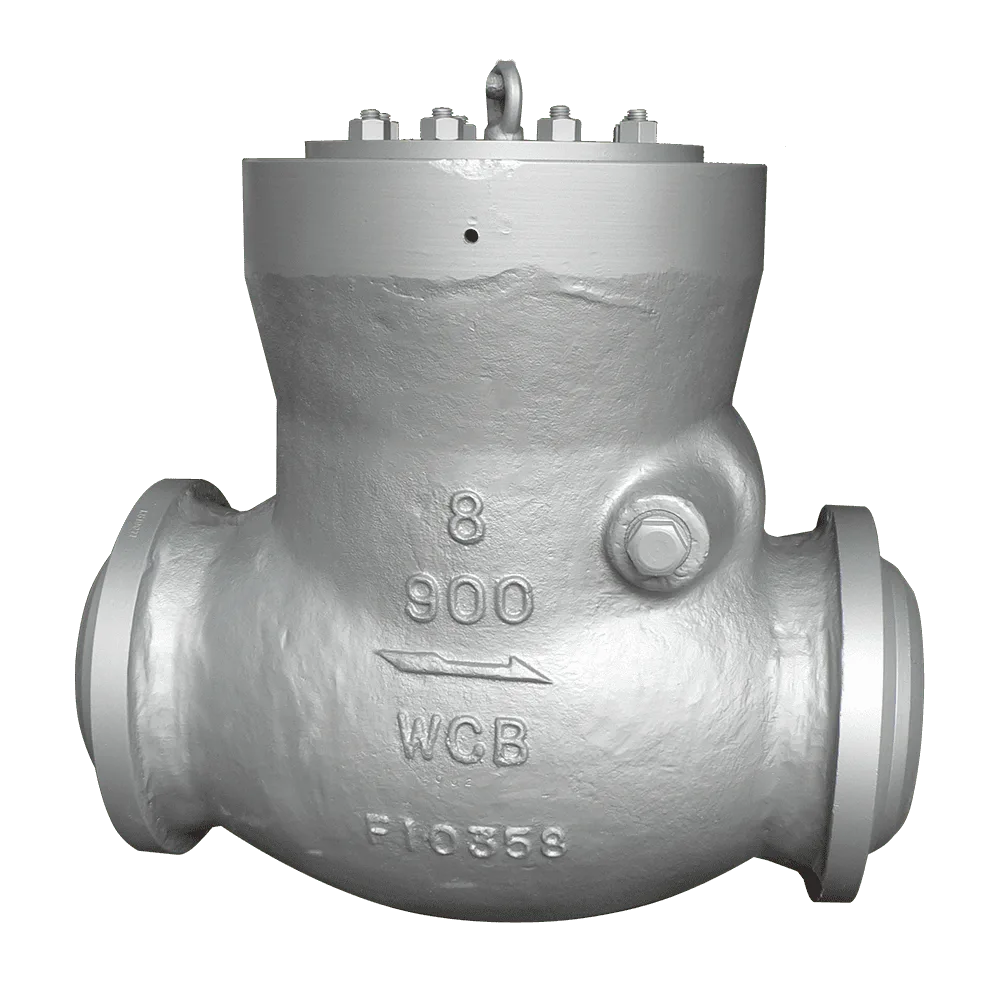
8″ Class 900 WCB pressure-seal check valve — check valves span far beyond utility pressure classes.
Installation and Maintenance Notes That Datasheets Omit
- Respect the flow arrow. Both types are directional. Installing a check valve backwards is among the most common commissioning faults in pump systems.
- Mind the orientation. Horizontal lines and vertical-up flow suit both designs. Vertical-down flow works against gravity and spring closure — swing discs can hang open, so confirm with the manufacturer before committing.
- Leave swing valves their space. The cover and the disc’s swing arc need clearance; a swing check tucked against an elbow can chatter in turbulent flow. A straight run of several pipe diameters upstream is the standard good practice.
- Plan dual-plate removal. A wafer body is extracted by spreading the flanges — schedule a spacer or plan the shutdown accordingly, because in-line cover access does not exist.
- Material follows the media. WC6 alloy bodies for steam and hot oil, CF8M for corrosive lines, WCB for general service — the alloy check valve below is a typical hot-oil specification, and our DIN check valve selection guide covers the European side of the same choices.
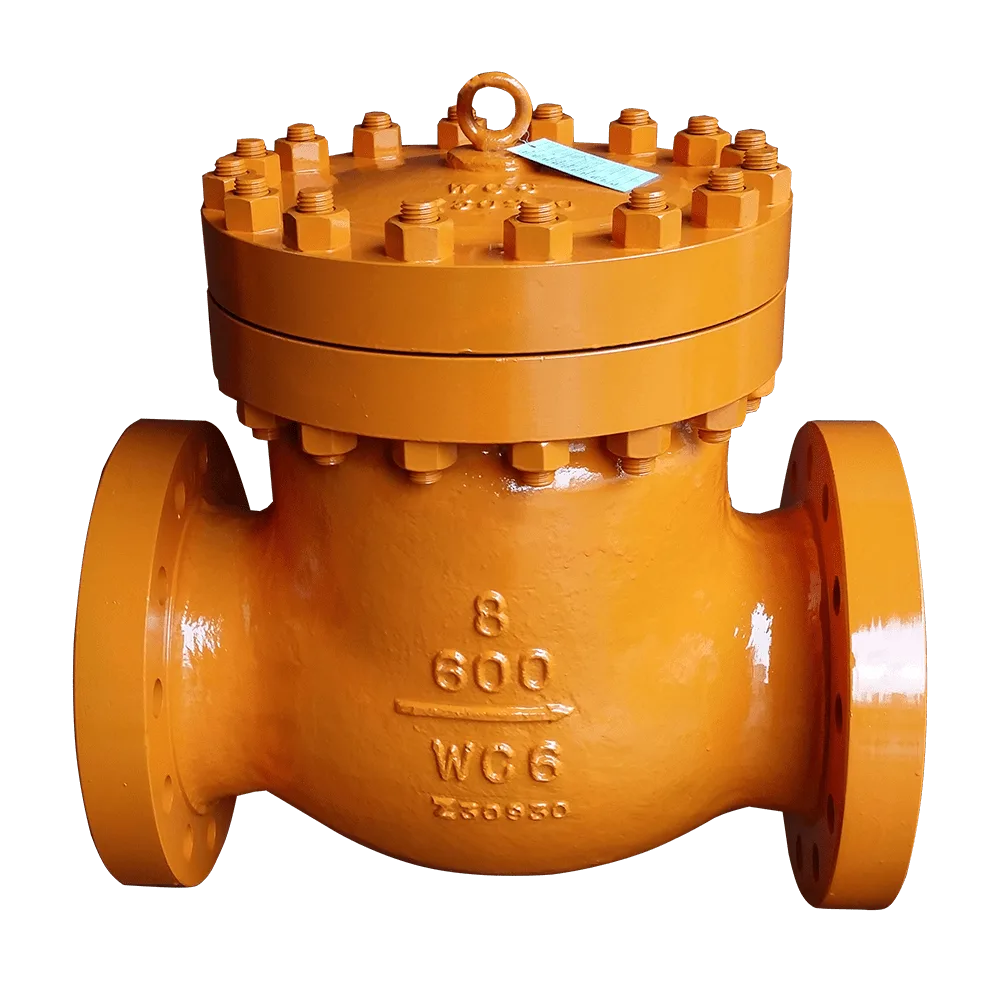
8″ Class 600 WC6 alloy check valve — material selection matters as much as body style.
A Five-Check Selection Route
- Measure the space. If face-to-face length or module weight is constrained, the wafer dual-plate wins by default.
- Count the pump starts. Frequent starts and multi-pump headers favor fast-closing dual plates; occasional-start, large-diameter lines suit swing checks with counterweights.
- Ask what slam can damage. Long transmission mains, surge-sensitive instrumentation or brittle fittings push the decision toward fast closure — or toward a dedicated silent check, which our spring-loaded and silent check valve guide compares.
- Check the media. Slurries, fibers and heavy fouling favor the open swing body; clean liquids suit dual plates.
- Fix the standard and the test. Utility and process checks are typically tested to API 598, wafer designs fall under API 594, and pipeline service invokes API 6D — quote the governing standard on the datasheet to keep procurement clean.
Frequently Asked Questions
Which check valve has the lower pressure drop?
Neither wins universally. A swing check offers a clear full bore at low velocities, while a dual-plate valve’s short body and fast closure can offset its intruding plates in many water and process duties. The honest answer is to compare the flow coefficient curves for the specific size and class — and our guide to the Kv flow coefficient explains how to read them.
Why does a swing check valve slam?
Because its disc has a long travel and significant mass. When the pump stops, the disc is still open while flow reverses, so it accelerates backward and strikes the seat with the energy of the reverse surge. Counterweights, dashpots or fast-closing alternatives such as dual-plate and silent checks reduce or eliminate the slam.
Can a wafer dual-plate check valve be installed vertically?
Yes, in vertical-up flow, where gravity and spring assist closure. Vertical-down flow is the caution case: gravity holds the plates toward open and spring force must overcome both gravity and any debris. Confirm the orientation with the manufacturer for vertical-down installations.
Which type handles dirty media better?
Swing checks. Their open, full-bore body and accessible disc tolerate slurries, fibers and solids far better than a dual-plate valve’s spring mechanism and hinge pins, which can jam when fouled. For heavy solids, a swing check with a resilient seat is the common specification.
Are dual-plate check valves full-bore?
No. The two plates and their spring retainer intrude into the bore even when open. That is acceptable for most liquid and gas duties, but lines that are pigged or require an unobstructed bore — and this includes many pipeline applications — should specify a swing check or a full-bore alternative.
What standards govern these check valves?
Wafer and dual-plate checks are commonly supplied to API 594, flanged swing checks to API 6D or BS 1868 depending on service, and pressure testing to API 598 across both. European projects may instead reference DIN or EN face-to-face series, so align the standard with the piping class before ordering.
Get the Right Check Valve from Sedelon
Swing and wafer dual-plate check valves are not competitors so much as different answers to the same backflow problem — one buys full-bore simplicity, the other buys speed and space. Sedelon manufactures both families in WCB, CF8M, WC6 and other materials at its Wenzhou works, from utility sizes to Class 900 pressure-seal bodies, with API 598 testing as standard. Tell us the line size, class, orientation and media, and our engineers will recommend the check valve type — and quote it — within one working day.
Send Your Check Valve Line Data
Size, class, orientation, media — Sedelon’s engineers confirm swing or dual-plate selection and return a quotation, usually within one working day.