



A piping specification line reads “globe valve, API 602, Class 800, socket weld” while the datasheet for the same two-inch line calls out “API 623, Class 150, flanged ends”. Both describe a small-bore steel globe valve, and both are correct — the standards govern different scopes and overlap in the NPS 1 to 2 (DN 25 to 50) range. Knowing which standard applies to your line prevents specification conflicts and quotation mismatches. This guide explains what each standard covers, how they differ, and when small-bore rules point to one over the other.
What API 602 Actually Covers
API 602 is the compact-valve standard. It covers small steel gate valves, globe valves, check valves and stop-check valves in sizes from NPS 1/4 up to NPS 2 (DN 8 to DN 50) and pressure classes from Class 150 through Class 2500. Most valves built to API 602 have forged bodies — ASTM A105 for carbon steel, A350 LF2 for low-temperature service, A182 F304/F316 for stainless, F11 or F22 for chrome-moly alloy — although the standard also accepts cast bodies. Compact forged construction is precisely the point: wall thickness, bonnet and stem details are optimized for small, high-pressure connections rather than for large castings.
The standard also defines the bonnet options buyers see on nameplates: bolted bonnet for full maintainability, welded bonnet for zero body-to-bonnet leak path, and pressure-seal bonnet for the highest classes. End connections are dominated by socket weld and threaded ends, with butt-weld and flanged ends available where the line demands them. Class 800 — the intermediate rating between Class 600 and 900 — exists almost exclusively inside the API 602 rating table, which is one of the clearest fingerprints of a compact forged valve.
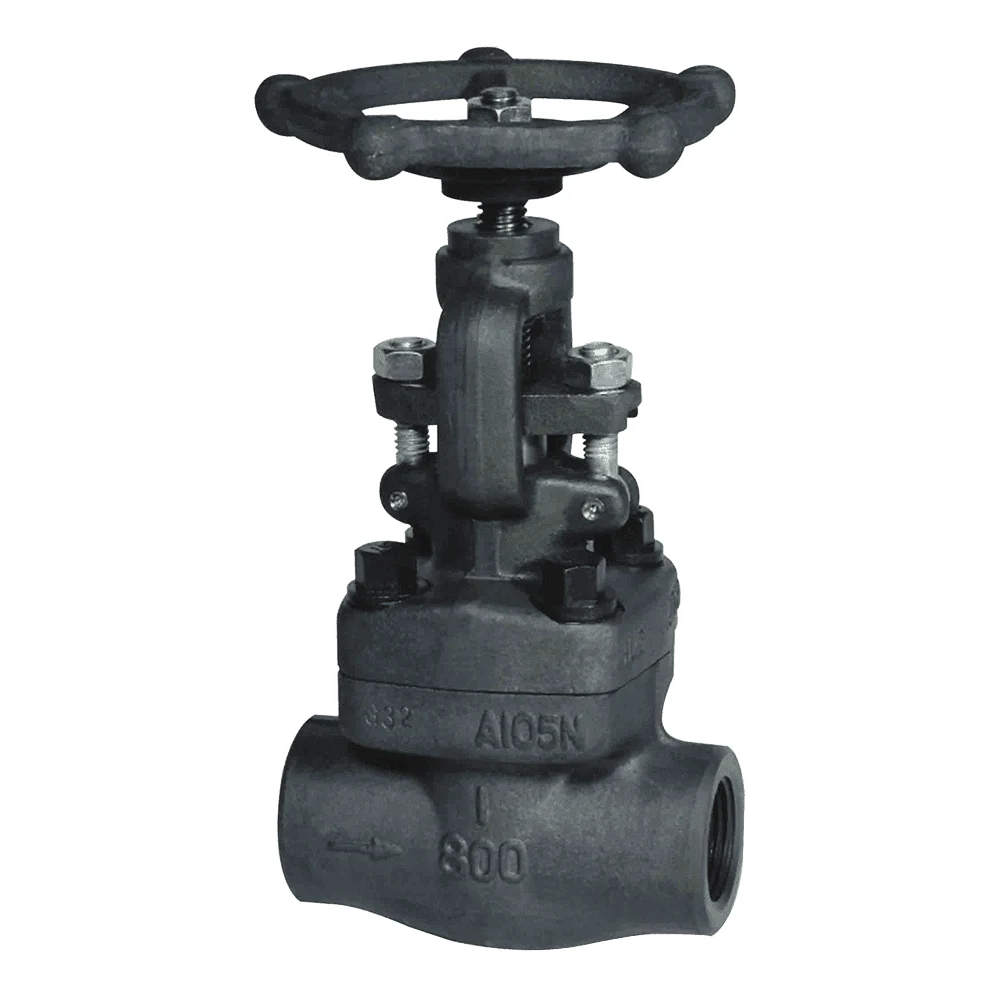
Sedelon forged globe valve to API 602: A105 body, Class 800 rating, bolted bonnet — a typical small-bore shut-off valve for process plants.
What API 623 Adds for Small-Bore Globe Valves
API 623 is narrower and, in a sense, more deliberate. Published as a dedicated globe valve standard, it covers steel globe valves with flanged or butt-welding ends and bolted bonnets, in sizes NPS 1 to NPS 2 (DN 25 to DN 50) and pressure classes from Class 150 to Class 1500. Where API 602 is a compact-valve family standard, API 623 focuses on making the small-bore globe valve a fully specified, serviceable piece of process equipment: body wall thickness aligned with ASME B16.34, defined stem guiding, controlled seat and disc sealing surfaces, and pressure testing to API 598.
In practice, API 623 answers a buyer’s question that API 602 was never designed to answer: “Give me a standardized, repairable, flanged small-bore globe valve with predictable wall thickness and leakage limits.” Refineries and petrochemical operators increasingly write API 623 into their small-bore process specifications for exactly that reason — the valve behaves like a full-size globe valve, just in a smaller frame.
API 602 vs API 623: Side-by-Side Comparison
The table below condenses the two standards into the factors that decide a purchase. The overlap zone — NPS 1 to 2, flanged or welded ends — is where most specification discussions happen.
| Aspect | API 602 | API 623 |
|---|---|---|
| Valve types covered | Gate, globe, check and stop-check compact valves | Globe valves only |
| Size range | NPS 1/4 – 2 (DN 8 – 50) | NPS 1 – 2 (DN 25 – 50) |
| Pressure classes | Class 150 – 2500, including Class 800 | Class 150 – 1500 |
| Body material emphasis | Forged steel (A105, LF2, F304/F316, F11/F22); cast accepted | Steel, cast or forged, with wall thickness per ASME B16.34 |
| Bonnet options | Bolted, welded or pressure-seal bonnet | Bolted bonnet |
| End connections | Socket weld, threaded, butt weld, flanged | Flanged or butt-welding ends |
| Design character | Compact, high-pressure, minimal envelope | Full-specification process globe valve in small sizes |
| Typical duty | Instrument, drain, vent, sample and injection lines | Small-bore process lines where maintainability matters |
If your specification cites both standards on the same line size, treat it as a signal to align documents rather than to pick one at random — usually one standard governs the valve type and the other was quoted for familiarity. The end connection itself often settles the debate; our socket weld vs butt weld vs flanged guide explains when each connection suits small-bore service.
When the Line Rules Point to API 602
API 602 is usually the right call when several of these describe the installation:
- The line is a genuinely small utility branch — drains, vents, instrument takes, chemical injection or sampling — where socket-weld or threaded ends keep the installation tight.
- Pressure is high for the bore size: Class 800, 1500 or 2500 compact ratings are the standard’s home ground.
- Space around the weld point is limited and a compact forged envelope fits where a flanged casting will not.
- Forged material properties matter — for example on high-pressure hydrogen or steam service where buyers prefer forged A105 or F11/F22 over castings; the trade-offs are the same as those in our forged vs cast valve body comparison.
- The scope includes not just globes but matched gate and check valves from the same compact family, so one standard covers the whole small-bore manifold.
Need API 602 compact forged globe valves?
Sedelon manufactures forged globe valves from NPS 1/4 to NPS 2 in A105, LF2, F304/F316 and alloy steels, with bolted, welded or pressure-seal bonnets. Send us the line class and size for a quotation.
When API 623 Is the Better Call
Choose API 623 when the small-bore line is a maintained part of the process plant rather than a disposable branch:
- The valve has flanged or butt-weld ends and is expected to be overhauled in place, not cut out — the bolted bonnet requirement reflects that.
- The owner’s specification explicitly references API 623, as many refinery small-bore standards now do.
- Wall thickness and leakage performance must be traceable to a dedicated globe valve standard with ASME B16.34-aligned bodies.
- The valve operates frequently or throttles, where a serviceable disc-and-seat arrangement earns its keep. For throttling duty on larger lines, see our guide to gear operated globe valves.
What Both Standards Share: Materials, Wall Thickness and Testing
It is easy to frame API 602 and API 623 as rivals, but on the shop floor they share the same engineering foundation. Body wall thickness ultimately traces to ASME B16.34 pressure-temperature ratings. Pressure testing follows API 598 for both — shell, seat and backseat tests with defined acceptance limits — so the hydrostatic bench you see below serves valves built to either standard. Materials come from the same ASTM melting families, and fire-safe or fugitive-emission requirements, when specified, apply identically to a Class 800 forged globe and a Class 300 API 623 valve alike.
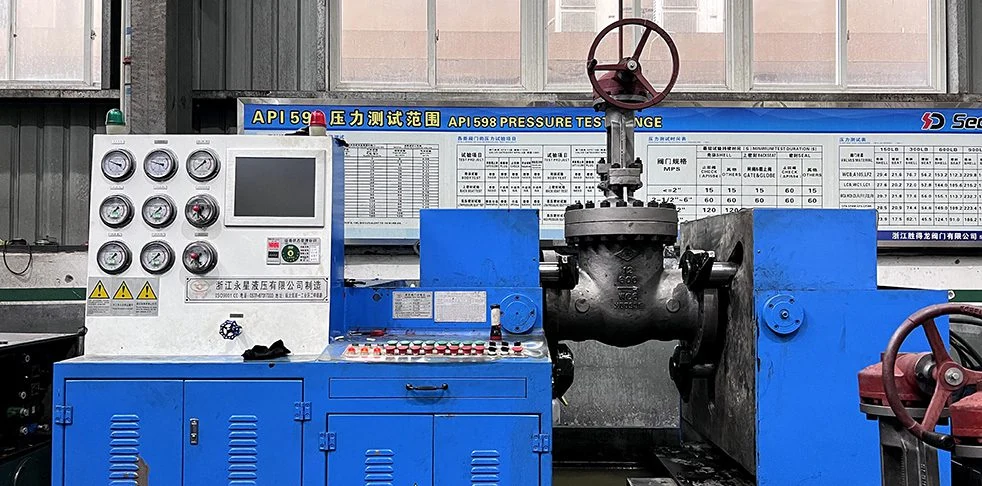
API 598 shell and seat testing on a globe valve — the acceptance test shared by API 602 and API 623 valves.
A Four-Step Selection Path for Small-Bore Globe Valves
- Fix the end connection first. Socket weld and threaded ends point to API 602 compact valves; flanged or butt-weld ends with a maintainable bolted bonnet point to API 623.
- Place the size and class inside the coverage map. Below NPS 1 or above Class 1500, API 602 is effectively the only option; inside the overlap, both standards are legitimate and the specification decides.
- Let the owner’s standard rule. When the piping class quotes one standard by name, quoting the other on the datasheet only creates procurement friction.
- Confirm the test and safety add-ons. Beyond API 598, hydrocarbon lines often add fire-safe testing to API 607 or API 6FA — our fire-safe valve guide explains the difference — and alloy selection follows the same logic as selecting an alloy globe valve.
Not Sure Which Standard Your Line Needs?
Send Sedelon the piping class extract — size, class, end connection and media — and our engineers will confirm whether API 602 or API 623 applies, then quote accordingly.
Frequently Asked Questions
Can one globe valve comply with both API 602 and API 623?
In the overlap zone — NPS 1 to 2 with flanged or butt-weld ends and a bolted bonnet — a valve can be built to satisfy both standards, but it will always be certified to one of them on the nameplate and test certificate. Buyers should nominate the governing standard rather than ask for dual compliance, because details such as wall thickness basis and rating tables differ between the two documents.
What sizes and pressure classes does API 602 cover?
API 602 covers compact steel valves from NPS 1/4 to NPS 2 (DN 8 to DN 50) in pressure classes 150, 300, 400, 600, 800, 1500 and 2500. The Class 800 intermediate rating is specific to this standard and is the most common rating for forged carbon steel globe valves in process plants.
Why is Class 800 only seen on API 602 valves?
Class 800 is an intermediate rating created for compact small-bore valves, positioned between Class 600 and Class 900. Because it appears in the API 602 rating tables rather than in ASME B16.34 flanged classes, it signals a forged compact valve with socket weld or threaded ends.
What is the difference between bolted, welded and pressure-seal bonnets?
A bolted bonnet can be removed for in-line maintenance and is the standard choice for maintainable valves. A welded bonnet eliminates the body-to-bonnet gasket entirely, trading maintainability for a sealed envelope. A pressure-seal bonnet uses line pressure to force the gasket tighter, which is why it appears on high-pressure API 602 valves in Class 1500 and above.
Which test standard applies, API 598 or API 6D?
Both API 602 and API 623 valves are pressure tested to API 598, which defines shell, seat and backseat test pressures and acceptance limits. API 6D belongs to pipeline valves — larger quarter-turn equipment — so a small-bore globe valve on a process line will carry API 598 test acceptance on its certificate.
Are forged bodies mandatory under API 602?
No. API 602 valves are most commonly forged, and forged A105, LF2, F304 or F316 bodies dominate the market, but the standard does not forbid cast bodies. What matters on the datasheet is the material specification — for example A105 versus A216 WCB — and the compact envelope that defines the API 602 family.
Specify Small-Bore Globe Valves with Sedelon
API 602 and API 623 are not competing answers — they are two layers of the same small-bore specification. Sedelon has manufactured industrial valves for about 30 years at its Wenzhou base, produces forged and cast globe valves to API 602, API 623, BS 1873 and related standards under an ISO 9001-certified quality system, and exports OEM/ODM worldwide. Share your line size, class and media, and our engineering team will confirm the governing standard, propose the bonnet and end-connection combination, and return a quotation within one working day.
Send Your Small-Bore Specification Today
API 602 compact forged globes or API 623 bolted-bonnet globes — quoted with full material and test documentation.