



 Skip to content

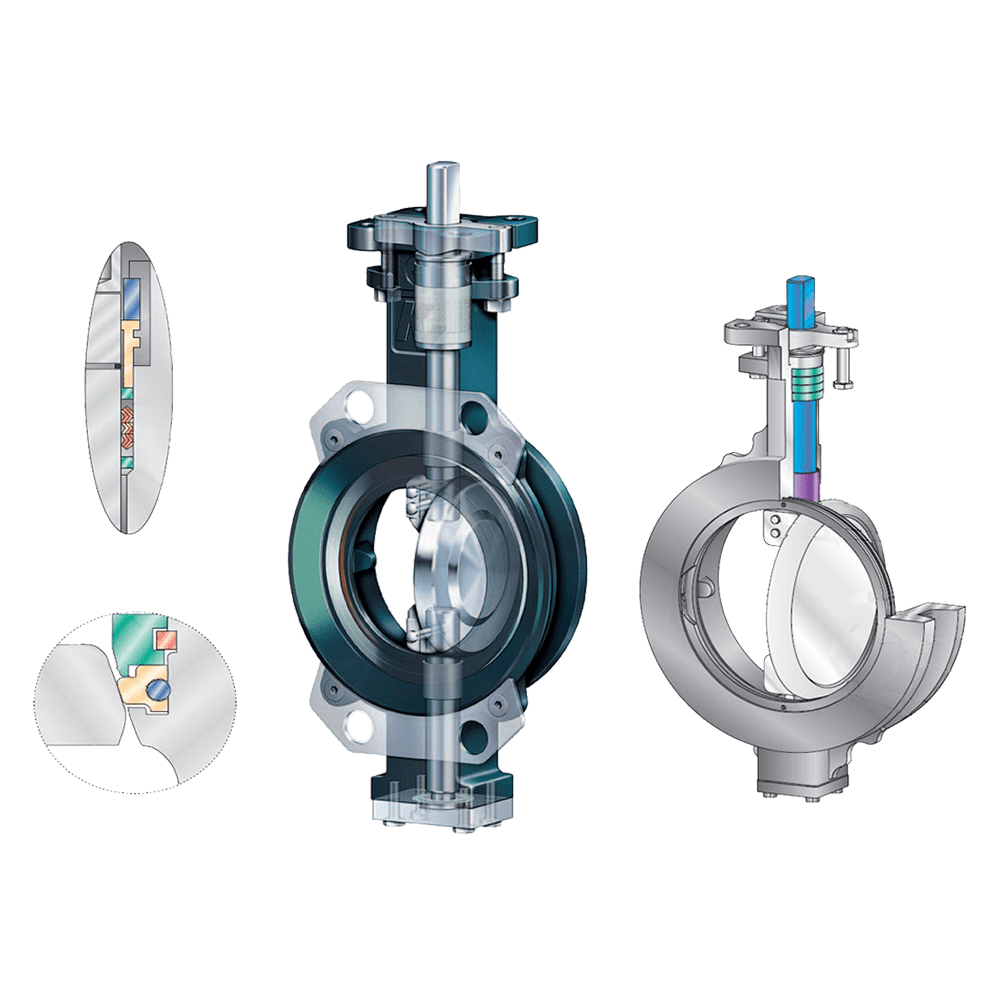
The Triple-Offset Design Principle
The defining feature of a triple-offset butterfly valve is that the sealing surfaces make contact only at the moment of closure.
First offset: The sealing surface is offset from the stem rotation axis.
Second offset: The stem axis is offset from the pipeline centerline.
Third offset: The conical seat geometry is angled relative to the pipeline axis.
The combined effect of these three offsets allows the disc to disengage completely from the seat along the conical sealing geometry as soon as it begins to rotate. No sliding friction occurs between the sealing surfaces throughout the operating stroke. As the valve closes, the disc wedges into the seat along the cone, increasing the sealing force as closure is completed.
Metal Sealing: Advantages and Trade-Offs
Because triple-offset butterfly valves use metal-to-metal sealing, the sealing surfaces are often hardfaced with Stellite or other hard alloys to provide wear resistance, high-temperature capability, and long service life. This makes them suitable for high-temperature, high-pressure, and particulate-laden applications.
However, metal sealing relies on wedge action rather than the elasticity of rubber. Operating torque is therefore significantly higher than that of a concentric butterfly valve, and large-diameter valves may require a gearbox or actuator. Sealing performance also depends heavily on machining and assembly accuracy; even minor deviations in the conical mating surfaces can compromise shutoff performance. In general, the achievable leakage performance of metal-to-metal sealing is less tight than that of soft-seated rubber valves.
Positioning Within the Butterfly Valve Range
Triple-offset butterfly valves occupy the higher-performance end of the butterfly valve range:
Concentric soft-seated butterfly valves: Suitable for clean media at ambient temperatures where economy is a priority.
Double-offset butterfly valves: Suitable for general service requiring durability and reliable operation.
Triple-offset butterfly valves: Preferred for high-temperature, particulate-laden, or demanding applications requiring long service life and friction-free operation.
The sealing material, cone angle, and actuator torque must be selected together to ensure reliable performance. Each valve is designed in accordance with API 609 and tested in accordance with API 598.
High-temperature steam and hot oil pipelines: Metal sealing provides high-temperature capability, friction-free operation, and long service life.
Pipelines carrying particulate-laden or scale-forming media: The non-rubbing sealing design reduces the risk of scratches caused by solid particles.
Large-diameter pipelines requiring long service life and minimal maintenance: Hardfaced sealing surfaces provide improved wear resistance.
Frequently operated pipelines: Friction-free movement throughout the operating stroke minimizes sealing surface wear.
High-parameter process pipelines: Select body and sealing surface materials according to the pressure rating, operating temperature, and process medium.
4. Selection Guidelines
Choosing Between Concentric, Double-Offset, and Triple-Offset Designs: Select a concentric soft-seated valve for clean media at ambient temperatures, a double-offset valve for general service, and a triple-offset valve for high-temperature, particulate-laden, or long-life applications.
Sealing Surface Materials: For high-temperature service or significant erosion, consider Stellite or other hard alloys applied by hardfacing. Select the sealing surface hardness and mating material combination according to the process medium and operating conditions.
Operating Torque: Metal-seated valves require higher torque. For large diameters or high differential pressures, provide a gearbox or actuator and calculate the required torque at the maximum differential pressure.
Installation Orientation: Install the valve according to the flow direction markings on the body to minimize uneven loading during closure.
Expected Leakage Performance: Metal-to-metal sealing may permit a small amount of leakage. The required leakage acceptance criteria must be agreed upon at the time of ordering in accordance with the applicable standard; soft-seat bubble-tight requirements should not be assumed.
5. Project Case Study
Customer: Honeywell UOP LLC, MalaysiaApplication: High-Temperature Process Pipelines in Refinery Hydrocracking and Reforming Units
The project involved DN 600, Class 300 high-temperature process pipelines operating at 400°C. The original soft-seated butterfly valves suffered from seat aging and failure at elevated temperatures, resulting in internal leakage and repeated plant load reductions.
Flowork supplied 42 DN 200–900, Class 300 triple-offset metal-seated butterfly valves featuring A216 WCB valve bodies, CF8M stainless steel discs, hardened 17-4 PH stems, Stellite 6 hardfaced metal sealing surfaces, a triple-offset design providing friction-free opening and closing, and flanged connections.
The valves were designed in accordance with API 609 Category B and underwent shell and seat leakage testing in accordance with API 598, witnessed by the UOP Quality Control Department.
Since commissioning in May 2022, the valves have operated continuously for 3 years with zero internal leakage. Plant load reductions decreased from 5 times per year to zero, and annual steam consumption decreased by approximately 6%.
6. Frequently Asked Questions (FAQs)
Q1: Why does a metal-seated butterfly valve require significantly higher operating torque than a rubber-seated valve?
Metal sealing relies on a wedging action along the conical sealing surfaces, requiring greater closing torque. Actuator sizing must be based on the required torque at the maximum differential pressure, not on the no-load torque.
Q2: Can metal-to-metal sealing achieve zero leakage?
Achieving absolute zero leakage with metal-to-metal sealing is difficult. A small amount of leakage may be permitted, depending on the design and test requirements. The acceptable leakage rate must be agreed upon at the time of ordering in accordance with the applicable standard; bubble-tight requirements for soft-seated valves should not be assumed.
Q3: What should I do if the valve becomes harder to operate at high temperatures?
Thermal expansion may change the clearances between the conical sealing surfaces. First, verify that the actual operating temperature matches the design conditions. Do not attempt to overcome the resistance by applying excessive torque. If necessary, have the manufacturer review the clearances and sealing geometry.
Q4: Can the valve remain in service if the sealing surfaces are scratched?
Minor scratches may still allow the valve to meet the agreed leakage acceptance criteria. If leakage exceeds the specified limit, the sealing surfaces should be repaired and lapped, or the sealing components should be replaced.
Class150
Triple Offset Butterfly Valve
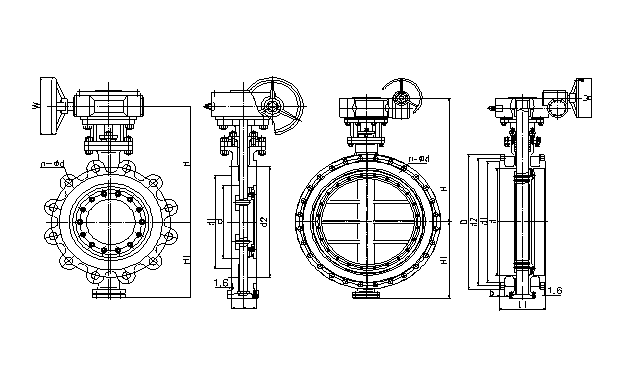
| NPS | in | 2 | 3 | 4 | 6 | 8 | 10 | 12 | 14 | 16 | 18 | 20 | 24 |
| d | mm | 51 | 76 | 102 | 152 | 203 | 254 | 305 | 337 | 387 | 438 | 489 | 591 |
| L(RF) | mm | 43 | 48 | 54 | 57 | 64 | 71 | 81 | 92 | 102 | 114 | 127 | 154 |
| \L1(RF) | mm | 108 | 114 | 127 | 140 | 152 | 165 | 178 | 190 | 216 | 222 | 229 | 267 |
| d1 | mm | 92 | 127 | 157 | 216 | 270 | 324 | 381 | 413 | 470 | 533 | 584 | 692 |
| d2 | mm | 120.5 | 152.5 | 190.5 | 241.5 | 298.5 | 362 | 432 | 476 | 540 | 578 | 635 | 749.5 |
| D | mm | 152 | 190 | 229 | 279 | 343 | 406 | 483 | 533 | 597 | 635 | 699 | 813 |
| b | mm | 16 | 19 | 24 | 26 | 29 | 31 | 32 | 35 | 37 | 40 | 43 | 48 |
| n-Фd | mm | 4-19 | 4-19 | 8-19 | 8-22 | 8-22 | 12-25 | 12-25 | 12-29 | 16-29 | 16-32 | 20-32 | 20-35 |
| H | mm | 225 | 255 | 285 | 332 | 386 | 427 | 498 | 510 | 540 | 585 | 642 | 693 |
| H1 | mm | 112 | 126 | 146 | 170 | 218 | 245 | 290 | 316 | 352 | 386 | 415 | 482 |
| W | mm | 300 | 300 | 300 | 300 | 300 | 300 | 500 | 500 | 600 | 600 | 600 | 600 |
Class300
Triple Offset Butterfly Valve
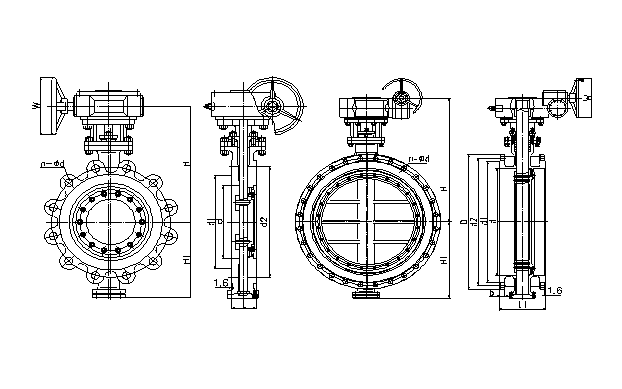
| NPS | in | 3 | 4 | 6 | 8 | 10 | 12 | 14 | 16 | 18 | 20 | 24 |
| d | mm | 76 | 102 | 152 | 203 | 254 | 305 | 337 | 387 | 432 | 483 | 584 |
| L(RF) | mm | 48 | 54 | 59 | 73 | 83 | 92 | 117 | 133 | 149 | 159 | 181 |
| \L1(RF) | mm | 114 | 127 | 140 | 152 | 165 | 178 | 190 | 216 | 222 | 229 | 267 |
| d1 | mm | 127 | 157 | 216 | 270 | 324 | 381 | 413 | 470 | 533 | 584 | 692 |
| d2 | mm | 168.5 | 200 | 270 | 330 | 387.5 | 451 | 514.5 | 571.5 | 628.5 | 686 | 813 |
| D | mm | 210 | 254 | 318 | 381 | 445 | 521 | 584 | 648 | 711 | 775 | 914 |
| b | mm | 29 | 32 | 37 | 42 | 48 | 51 | 54 | 58 | 61 | 64 | 70 |
| n-Фd | mm | 8-22 | 8-22 | 12-22 | 12-25 | 16-29 | 16-32 | 20-32 | 20-35 | 24-35 | 24-35 | 24-41 |
| H | mm | 265 | 290 | 355 | 418 | 456 | 498 | 547 | 582 | 651 | 704 | 780 |
| H1 | mm | 130 | 150 | 185 | 236 | 273 | 313 | 338 | 392 | 420 | 465 | 532 |
| W | mm | 300 | 300 | 300 | 500 | 500 | 600 | 600 | 600 | 600 | 600 | 600 |
API Trim NO.
Table
|
No |
Seat |
Gate、disc 、ball or body |
Stem |
No |
Seat |
Gate、disc 、ball or body |
Stem | |
| 01 | 13Cr | 13Cr | 13Cr | 31 | STELLITE | 321SS | 321SS | |
| 02 | 304SS | 304SS | 304SS | 32 | STELLITE | STELLITE | 321SS | |
| 03 | 310SS | 310SS | 310SS | 33 | 347SS | 347SS | 347SS | |
| 04 | HARD 13Cr | HARD 13Cr | 13Cr | 34 | STELLITE | 347SS | 347SS | |
| 05 | STELLITE | STELLITE | 13Cr | 35 | NICKEL ALLOY | 13Cr | 13Cr | |
| 06 | Cu-Ni | 13Cr | 13Cr | 36 | A105/PTFE | A105+ENP | A105+ENP | |
| 07 | 13Cr | HARD 13Cr | 13Cr | 37 | A105/PTFE | WCB+ENP | A105+ENP | |
| 08 | STELLITE | 13Cr | 13Cr | 38 | 13Cr/PTFE | 13Cr | 13Cr | |
| 09 | Cu-Ni | Cu-Ni | Cu-Ni | 39 | 304SS/PTFE | 304SS | 304SS | |
| 10 | 316SS | 316SS | 316SS | 40 | 316SS/PTFE | 316SS | 316SS | |
| 11 | Cu-Ni | STELLITE | Cu-Ni | 41 | A105/RPTFE | A105+ENP | A105+ENP | |
| 12 | STELLITE | 316SS | 316SS | 42 | A105/RPTFE | WCB+ENP | A105+ENP | |
| 13 | ALLOY 20 | ALLOY 20 | ALLOY 20 | 43 | 13Cr/RPTFE | 13Cr | 13Cr | |
| 14 | STELLITE | ALLOY 20 | ALLOY 20 | 44 | 304SS/RPTFE | 304SS | 304SS | |
| 15 | STELLITE | STELLITE | 304SS | 45 | 316SS/RPTFE | 316SS | 316SS | |
| 16 | STELLITE | STELLITE | 316SS | 46 | A105/NYLON | A105+ENP | A105+ENP | |
| 17 | STELLITE | STELLITE | 347SS | 47 | A105/NYLON | WCB+ENP | A105+ENP | |
| 18 | STELLITE | STELLITE | ALLOY 20 | 48 | A105/NYLON | 304SS | 304SS | |
| 19 | MONEL | MONEL | MONEL | 49 | A105/NYLON | 316SS | 316SS | |
| 20 | BRONZE | BRONZE | 13Cr | 50 | 13Cr/NYLON | 13Cr | 13Cr | |
| 21 | HASTELLOY B | HASTELLOY B | HASTELLOY B | 51 | 304SS/NYLON | 304SS | 304SS | |
| 22 |
| HASTELLOY C | HASTELLOY C | 52 | 316SS/NYLON | 316SS | 316SS | |
| 23 | STELLITE | 304SS | 304SS | 53 | A105/PEEK | A105+ENP | A105+ENP | |
| 24 | 304LSS | 304LSS | 304LSS | 54 | A105/PEEK | WCB+ENP | A105+ENP | |
| 25 | STELLITE | 304LSS | 304LSS | 55 | 13Cr/PEEK | 13Cr | 13Cr | |
| 26 | STELLITE | STELLITE | 304LSS | 56 | 304SS/PEEK | 304SS | 304SS | |
| 27 | 316LSS | 316LSS | 316LSS | 57 | 316SS/PEEK | 316SS | 316SS | |
| 28 | STELLITE | 316LSS | 316LSS |
|
|
|
|
|
| 29 | STELLITE | STELLITE | 316LSS |
|
|
| ||
| 30 | 321SS | 321SS | 321SS |
|
|
|
| |
Note:please indicate it directly in the
order for the internal part’smaterial uncovered in the table
 Optimized by Seraphinite Accelerator