



 Skip to content

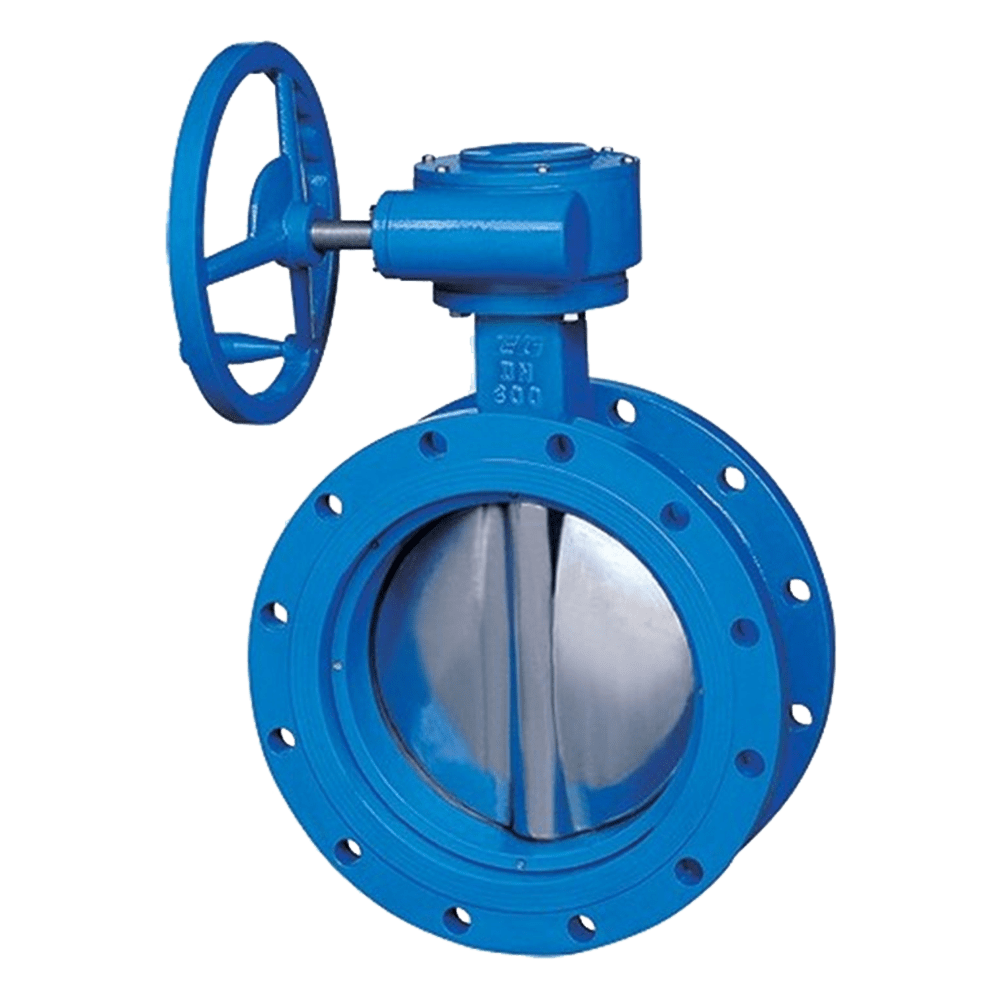
A concentric butterfly valve features a stem positioned precisely through the geometric center of the disc, with the stem and disc arranged concentrically within the valve body. During opening and closing, the disc moves into or away from the resilient rubber seat, relying on elastic compression of the seat to achieve shutoff. This design can provide bubble-tight sealing under suitable operating conditions.
With fewer components, low flow resistance, lightweight construction, and relatively low manufacturing costs, concentric butterfly valves are an economical alternative to gate valves of the same nominal size in low-pressure, ambient-temperature clean water and cooling water systems.
However, the design has an inherent limitation: the disc remains in contact with the rubber seat throughout its rotation. As the disc moves between the fully closed and fully open positions, its edge slides against the seat, creating friction and wear. Rubber seats have limited abrasion resistance, so media containing suspended solids or applications involving frequent operation can accelerate seat deterioration. Temperature resistance is also limited by the selected elastomer. Depending on the material grade and operating conditions, conventional rubber seats are commonly used within an approximate range of 80–120°C or below. At higher temperatures, the elastomer may soften, age, or lose elasticity, compromising sealing performance. Concentric butterfly valves are therefore best suited to relatively clean media, moderate temperatures, and applications that do not require excessive operating cycles.
For seawater service, the valve body may be manufactured from epoxy-coated ductile iron or selected from corrosion-resistant materials such as CF8M stainless steel and C95800 nickel-aluminium bronze. The stem is typically made from 316 stainless steel or duplex stainless steel, while the seat may use EPDM or another elastomer qualified for seawater exposure.
These valves are commonly available in wafer-type and flanged configurations. Wafer-type valves are clamped between the mating pipeline flanges, minimizing installation length. However, they rely on the pipeline flanges for retention and generally cannot be used for dead-end service unless specifically designed and rated for that application. Flanged valves have integral end flanges and can be independently supported at the connection, allowing one side to be disconnected where the installation and isolation arrangements permit.
Each valve is designed in accordance with API 609 and tested in accordance with API 598.
Circulating Cooling Water and Utility Water Pipelines: Simple construction and economical operation for general water service.
Seawater Intake and Discharge Systems: CF8M stainless steel or C95800 nickel-aluminium bronze components combined with seawater-compatible EPDM seats.
Water Supply and Wastewater Treatment: Fast quarter-turn operation and low flow resistance in suitable low-pressure applications.
Space-Constrained Pipe Racks and Pump Rooms: Wafer-type construction minimizes face-to-face dimensions and installation space.
Ambient-Temperature Clean Water Systems: A cost-effective alternative to gate valves of the same nominal size where the operating conditions are suitable.
Valve Design and Operating Temperature: Select concentric butterfly valves for clean media and temperatures within the allowable range of the selected elastomer. For higher temperatures, abrasive media, or more demanding operating cycles, consider double-offset or triple-offset butterfly valves with an appropriate sealing design.
Seat Material: EPDM is commonly used for clean water and many seawater applications. Nitrile rubber (NBR) may be suitable for oil-containing media, subject to compatibility with the specific oil and operating conditions. For seawater service, select an EPDM compound specifically qualified for the intended application.
Body Material: Epoxy-coated ductile iron is a common economical choice for general water service. CF8M stainless steel or C95800 nickel-aluminium bronze may be selected for seawater and chloride-containing environments after evaluating the corrosion conditions.
End Connection: Wafer-type valves are preferred where installation space is limited and both pipeline flanges provide the required clamping. For applications requiring one-sided disconnection or dead-end service, select a suitably rated flanged or lug-type design.
Installation and Pipeline Cleaning: Thoroughly flush or clean the pipeline before commissioning. Tighten flange bolts evenly in a diagonal sequence and prevent welding slag, scale, and other debris from damaging the rubber seat.
Operating Method: For valves DN 200 and larger, or where remote operation is required, consider a gearbox or actuator based on the required operating torque, operating frequency, and control requirements.
Ratchaburi World Cogeneration Power Plant, Thailand — Circulating Cooling Water and Seawater Intake Pipelines
At the Ratchaburi World Cogeneration Power Plant in Thailand, the circulating cooling water and seawater intake pipelines operated at DN 800 and PN 10 under high-salinity seawater conditions. The originally installed concentric butterfly valves experienced disc corrosion and deterioration of the sealing surfaces, resulting in external leakage after approximately 14 months of service. Each failure required a shutdown for valve replacement and interrupted cooling operations for approximately five hours.
Flowork supplied 88 concentric butterfly valves in sizes DN 200–900, PN 10, featuring GGG40 ductile iron bodies with electrostatically applied epoxy coating, CF8M stainless steel discs, 316 stainless steel stems, and integrally vulcanized EPDM seats designed to provide bubble-tight shutoff under the specified operating conditions. The valves featured wafer-type connections and were designed in accordance with API 609. Shell and seat leakage testing was completed in accordance with API 598, witnessed by the Ratchaburi Engineering Department.
Since commissioning in July 2022, the valves have operated continuously for three years without external leakage. Shutdowns for valve replacement decreased from four per year to zero, and cooling water system availability increased to 99.4%.
6. Frequently Asked Questions (FAQs)
Q1: What should be done if a concentric butterfly valve continues to leak after closure?
The most common causes include damage to the rubber seat from foreign particles, seat wear, or elastomer aging and loss of elasticity. Depressurize and isolate the pipeline before inspecting the seat. Remove debris from the valve and pipeline, and replace the seat if it is damaged or can no longer provide the required sealing performance.
Q2: Why does a concentric butterfly valve become difficult to operate?
Common causes include corrosion or seizure of the valve stem, excessive seat friction, and elastomer swelling caused by temperature or chemical incompatibility. Isolate and depressurize the pipeline before inspection. Check the stem, bearings, and seat for corrosion, deposits, or deformation, and apply only lubricants approved for the valve materials and process service.
Q3: What happens if one pipeline flange is removed from a wafer-type butterfly valve?
The valve body may lose its clamping support and fall or shift out of position. The pipeline must be properly isolated, depressurized, and mechanically supported before disassembly. Wafer-type valves should not be used for dead-end service unless the specific design is explicitly rated for that configuration.
Q4: How often should a rubber seat be replaced?
The replacement interval depends on the process medium, operating temperature, chemical compatibility, solids content, and frequency of operation. Applications involving abrasive particles or frequent cycling generally require more frequent inspection. Replace the seat when leakage, visible damage, excessive wear, or loss of sealing performance is detected.
Class150
Concentric Butterly Valve
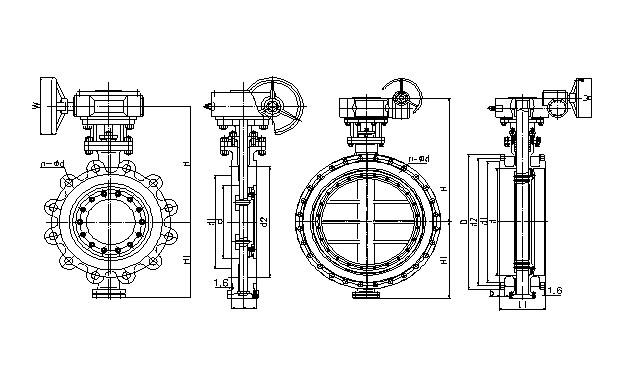
| NPS | in | 2 | 3 | 4 | 6 | 8 | 10 | 12 | 14 | 16 | 18 | 20 | 24 |
| d | mm | 51 | 76 | 102 | 152 | 203 | 254 | 305 | 337 | 387 | 438 | 489 | 591 |
| L(RF) | mm | 43 | 48 | 54 | 57 | 64 | 71 | 81 | 92 | 102 | 114 | 127 | 154 |
| \L1(RF) | mm | 108 | 114 | 127 | 140 | 152 | 165 | 178 | 190 | 216 | 222 | 229 | 267 |
| d1 | mm | 92 | 127 | 157 | 216 | 270 | 324 | 381 | 413 | 470 | 533 | 584 | 692 |
| d2 | mm | 120.5 | 152.5 | 190.5 | 241.5 | 298.5 | 362 | 432 | 476 | 540 | 578 | 635 | 749.5 |
| D | mm | 152 | 190 | 229 | 279 | 343 | 406 | 483 | 533 | 597 | 635 | 699 | 813 |
| b | mm | 16 | 19 | 24 | 26 | 29 | 31 | 32 | 35 | 37 | 40 | 43 | 48 |
| n-Фd | mm | 4-19 | 4-19 | 8-19 | 8-22 | 8-22 | 12-25 | 12-25 | 12-29 | 16-29 | 16-32 | 20-32 | 20-35 |
| H | mm | 225 | 255 | 285 | 332 | 386 | 427 | 498 | 510 | 540 | 585 | 642 | 693 |
| H1 | mm | 112 | 126 | 146 | 170 | 218 | 245 | 290 | 316 | 352 | 386 | 415 | 482 |
| W | mm | 300 | 300 | 300 | 300 | 300 | 300 | 500 | 500 | 600 | 600 | 600 | 600 |
Class300
Concentric Butterly Valve
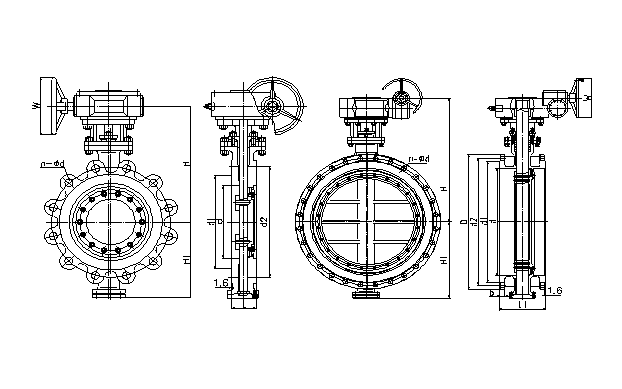
| NPS | in | 3 | 4 | 6 | 8 | 10 | 12 | 14 | 16 | 18 | 20 | 24 |
| d | mm | 76 | 102 | 152 | 203 | 254 | 305 | 337 | 387 | 432 | 483 | 584 |
| L(RF) | mm | 48 | 54 | 59 | 73 | 83 | 92 | 117 | 133 | 149 | 159 | 181 |
| \L1(RF) | mm | 114 | 127 | 140 | 152 | 165 | 178 | 190 | 216 | 222 | 229 | 267 |
| d1 | mm | 127 | 157 | 216 | 270 | 324 | 381 | 413 | 470 | 533 | 584 | 692 |
| d2 | mm | 168.5 | 200 | 270 | 330 | 387.5 | 451 | 514.5 | 571.5 | 628.5 | 686 | 813 |
| D | mm | 210 | 254 | 318 | 381 | 445 | 521 | 584 | 648 | 711 | 775 | 914 |
| b | mm | 29 | 32 | 37 | 42 | 48 | 51 | 54 | 58 | 61 | 64 | 70 |
| n-Фd | mm | 8-22 | 8-22 | 12-22 | 12-25 | 16-29 | 16-32 | 20-32 | 20-35 | 24-35 | 24-35 | 24-41 |
| H | mm | 265 | 290 | 355 | 418 | 456 | 498 | 547 | 582 | 651 | 704 | 780 |
| H1 | mm | 130 | 150 | 185 | 236 | 273 | 313 | 338 | 392 | 420 | 465 | 532 |
| W | mm | 300 | 300 | 300 | 500 | 500 | 600 | 600 | 600 | 600 | 600 | 600 |
API Trim NO.
Table
|
No |
Seat |
Gate、disc 、ball or body |
Stem |
No |
Seat |
Gate、disc 、ball or body |
Stem | |
| 01 | 13Cr | 13Cr | 13Cr | 31 | STELLITE | 321SS | 321SS | |
| 02 | 304SS | 304SS | 304SS | 32 | STELLITE | STELLITE | 321SS | |
| 03 | 310SS | 310SS | 310SS | 33 | 347SS | 347SS | 347SS | |
| 04 | HARD 13Cr | HARD 13Cr | 13Cr | 34 | STELLITE | 347SS | 347SS | |
| 05 | STELLITE | STELLITE | 13Cr | 35 | NICKEL ALLOY | 13Cr | 13Cr | |
| 06 | Cu-Ni | 13Cr | 13Cr | 36 | A105/PTFE | A105+ENP | A105+ENP | |
| 07 | 13Cr | HARD 13Cr | 13Cr | 37 | A105/PTFE | WCB+ENP | A105+ENP | |
| 08 | STELLITE | 13Cr | 13Cr | 38 | 13Cr/PTFE | 13Cr | 13Cr | |
| 09 | Cu-Ni | Cu-Ni | Cu-Ni | 39 | 304SS/PTFE | 304SS | 304SS | |
| 10 | 316SS | 316SS | 316SS | 40 | 316SS/PTFE | 316SS | 316SS | |
| 11 | Cu-Ni | STELLITE | Cu-Ni | 41 | A105/RPTFE | A105+ENP | A105+ENP | |
| 12 | STELLITE | 316SS | 316SS | 42 | A105/RPTFE | WCB+ENP | A105+ENP | |
| 13 | ALLOY 20 | ALLOY 20 | ALLOY 20 | 43 | 13Cr/RPTFE | 13Cr | 13Cr | |
| 14 | STELLITE | ALLOY 20 | ALLOY 20 | 44 | 304SS/RPTFE | 304SS | 304SS | |
| 15 | STELLITE | STELLITE | 304SS | 45 | 316SS/RPTFE | 316SS | 316SS | |
| 16 | STELLITE | STELLITE | 316SS | 46 | A105/NYLON | A105+ENP | A105+ENP | |
| 17 | STELLITE | STELLITE | 347SS | 47 | A105/NYLON | WCB+ENP | A105+ENP | |
| 18 | STELLITE | STELLITE | ALLOY 20 | 48 | A105/NYLON | 304SS | 304SS | |
| 19 | MONEL | MONEL | MONEL | 49 | A105/NYLON | 316SS | 316SS | |
| 20 | BRONZE | BRONZE | 13Cr | 50 | 13Cr/NYLON | 13Cr | 13Cr | |
| 21 | HASTELLOY B | HASTELLOY B | HASTELLOY B | 51 | 304SS/NYLON | 304SS | 304SS | |
| 22 |
| HASTELLOY C | HASTELLOY C | 52 | 316SS/NYLON | 316SS | 316SS | |
| 23 | STELLITE | 304SS | 304SS | 53 | A105/PEEK | A105+ENP | A105+ENP | |
| 24 | 304LSS | 304LSS | 304LSS | 54 | A105/PEEK | WCB+ENP | A105+ENP | |
| 25 | STELLITE | 304LSS | 304LSS | 55 | 13Cr/PEEK | 13Cr | 13Cr | |
| 26 | STELLITE | STELLITE | 304LSS | 56 | 304SS/PEEK | 304SS | 304SS | |
| 27 | 316LSS | 316LSS | 316LSS | 57 | 316SS/PEEK | 316SS | 316SS | |
| 28 | STELLITE | 316LSS | 316LSS |
|
|
|
|
|
| 29 | STELLITE | STELLITE | 316LSS |
|
|
| ||
| 30 | 321SS | 321SS | 321SS |
|
|
|
| |
Note:please indicate it directly in the
order for the internal part’smaterial uncovered in the table
 Optimized by Seraphinite Accelerator