


 Skip to content

Butt Welded Dimensions:ANSI B16.25
Design and Manufacture:API 6D
Pressure Test:API598
Materials:WCB 、WC6 、WC9 、CF8、 CF8M、 CF3、 CF3M 、CN7M、LC1
LC2、LC3、LCB、LCC、Monel、 20# Alloys、4A、5A、C95800、C95500、A105、 F304 、F304L 、F316 、F316L、LF1 、LF2、LF3、LF9、 F51、F53、F11、F22, ect.
The valve contains a spherical disc (the ball) with a central bore. Turning the lever 90° rotates the ball so the bore either lines up with the pipeline (open) or blocks it at right angles (closed). Because the motion is a single quarter turn, the valve goes from fully open to fully closed in one swift movement, and the lever orientation always indicates the flow state — parallel to the pipe means open, perpendicular means closed.
| Service / Media | Body | Ball | Stem | Seat |
|---|---|---|---|---|
| General water / air / oil | WCB (A216) | A105 / F304 | A182 F6a | PTFE / RPTFE |
| Corrosive / chemical | CF8M (316) | F316 | F316 | RPTFE / PEEK |
| Cryogenic LNG | CF8 / LCB | F304 | F304 | PCTFE / PEEK |
| High-temp steam / oil | WC6 / WC9 | F11 / F22 | F11 | Grafoil / metal |
| Low-temp −46°C | LCB / LCC | F304 | F304 | PCTFE |
| Offshore / seawater | Duplex F51 / F53 | F51 | F51 | RPTFE |
| Sour service (H2S) | A352 LCB (NACE) | F304 | F6a (NACE) | PEEK |
Lever operated ball valves are widely used in oil & gas pipelines, water treatment and HVAC systems, chemical processing, power plants, refineries, tank farms and general industrial utilities where quick, reliable manual on/off control is needed on lines up to NPS 10″.
What is a lever operated ball valve used for?
It provides fast quarter-turn manual open/close control for on/off service; the lever position gives an at-a-glance open/closed indication, ideal for lines that are operated by hand rather than automated.
Lever vs gear operated ball valve — which should I choose?
Choose a lever operated ball valve for smaller, easily reached lines where hand torque is enough. For larger diameters or higher pressures where hand torque is too high, use a gear operated ball valve that multiplies input force through a gearbox.
Floating vs trunnion ball — which do I need?
Lever operated valves in NPS 2″–10″ use a floating ball seated by line pressure. For very large bore or high-pressure service, a trunnion mounted ball valve with a supported ball is the better choice.
What end connections are available?
Flanged ends to ANSI B16.5 and butt-weld ends to ANSI B16.25; face-to-face dimensions follow ANSI B16.10.
What are the pressure and temperature limits?
Standard range is Class 150–300; the usable temperature depends on the body and seat material (e.g. PTFE seats suit roughly −29°C to +180°C, metal seats go higher).
How can I tell if the valve is open or closed?
The lever points parallel to the pipe when open and perpendicular (90°) when closed — no separate indicator is required.
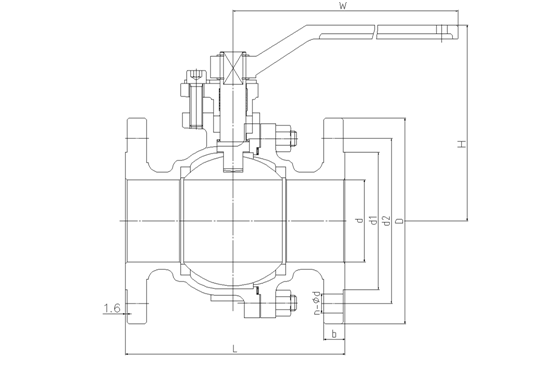
Class150
Hand lever ball valve

| NPS | in | 2 | 2 1/2 | 3 | 4 | 5 | 6 | 8 | 10 |
| d | mm | 51 | 64 | 76 | 102 | 127 | 152 | 203 | 254 |
| L(RF) | mm | 178 | 190 | 203 | 229 | 356 | 394 | 457 | 533 |
| d1 | mm | 92 | 105 | 127 | 157 | 186 | 216 | 270 | 324 |
| d2 | mm | 120.5 | 139.5 | 152.5 | 190.5 | 216 | 241.5 | 298.5 | 362 |
| D | mm | 152 | 178 | 190 | 229 | 254 | 279 | 343 | 406 |
| b | mm | 16 | 18 | 19 | 24 | 24 | 26 | 29 | 31 |
| n-Фd | mm | 4-19 | 4-19 | 4-19 | 8-19 | 8-22 | 8-22 | 8-22 | 12-25 |
| H | mm | 110 | 130 | 150 | 180 | 220 | 270 | 340 | 350 |
| W | mm | 200 | 290 | 290 | 360 | 600 | 800 | 1000 | 1200 |
Class300
Hand lever ball valve
| NPS | in | 2 | 2 1/2 | 3 | 4 | 5 | 6 | 8 |
| d | mm | 51 | 64 | 76 | 102 | 127 | 152 | 203 |
| L(RF) | mm | 216 | 241 | 283 | 305 | 381 | 403 | 502 |
| d1 | mm | 92 | 105 | 127 | 157 | 186 | 216 | 270 |
| d2 | mm | 127 | 149 | 168.5 | 200 | 235 | 270 | 330 |
| D | mm | 165 | 190 | 210 | 254 | 279 | 318 | 381 |
| b | mm | 23 | 26 | 29 | 32 | 35 | 37 | 42 |
| n-Фd | mm | 8-19 | 8-22 | 8-22 | 8-22 | 8-22 | 12-22 | 12-25 |
| H | mm | 140 | 160 | 180 | 208 | 220 | 290 | 300 |
| W | mm | 200 | 290 | 290 | 360 | 600 | 800 | 1000 |
API Trim NO.
Table
|
No |
Seat |
Gate、disc 、ball or body |
Stem |
No |
Seat |
Gate、disc 、ball or body |
Stem | |
| 01 | 13Cr | 13Cr | 13Cr | 31 | STELLITE | 321SS | 321SS | |
| 02 | 304SS | 304SS | 304SS | 32 | STELLITE | STELLITE | 321SS | |
| 03 | 310SS | 310SS | 310SS | 33 | 347SS | 347SS | 347SS | |
| 04 | HARD 13Cr | HARD 13Cr | 13Cr | 34 | STELLITE | 347SS | 347SS | |
| 05 | STELLITE | STELLITE | 13Cr | 35 | NICKEL ALLOY | 13Cr | 13Cr | |
| 06 | Cu-Ni | 13Cr | 13Cr | 36 | A105/PTFE | A105+ENP | A105+ENP | |
| 07 | 13Cr | HARD 13Cr | 13Cr | 37 | A105/PTFE | WCB+ENP | A105+ENP | |
| 08 | STELLITE | 13Cr | 13Cr | 38 | 13Cr/PTFE | 13Cr | 13Cr | |
| 09 | Cu-Ni | Cu-Ni | Cu-Ni | 39 | 304SS/PTFE | 304SS | 304SS | |
| 10 | 316SS | 316SS | 316SS | 40 | 316SS/PTFE | 316SS | 316SS | |
| 11 | Cu-Ni | STELLITE | Cu-Ni | 41 | A105/RPTFE | A105+ENP | A105+ENP | |
| 12 | STELLITE | 316SS | 316SS | 42 | A105/RPTFE | WCB+ENP | A105+ENP | |
| 13 | ALLOY 20 | ALLOY 20 | ALLOY 20 | 43 | 13Cr/RPTFE | 13Cr | 13Cr | |
| 14 | STELLITE | ALLOY 20 | ALLOY 20 | 44 | 304SS/RPTFE | 304SS | 304SS | |
| 15 | STELLITE | STELLITE | 304SS | 45 | 316SS/RPTFE | 316SS | 316SS | |
| 16 | STELLITE | STELLITE | 316SS | 46 | A105/NYLON | A105+ENP | A105+ENP | |
| 17 | STELLITE | STELLITE | 347SS | 47 | A105/NYLON | WCB+ENP | A105+ENP | |
| 18 | STELLITE | STELLITE | ALLOY 20 | 48 | A105/NYLON | 304SS | 304SS | |
| 19 | MONEL | MONEL | MONEL | 49 | A105/NYLON | 316SS | 316SS | |
| 20 | BRONZE | BRONZE | 13Cr | 50 | 13Cr/NYLON | 13Cr | 13Cr | |
| 21 | HASTELLOY B | HASTELLOY B | HASTELLOY B | 51 | 304SS/NYLON | 304SS | 304SS | |
| 22 |
| HASTELLOY C | HASTELLOY C | 52 | 316SS/NYLON | 316SS | 316SS | |
| 23 | STELLITE | 304SS | 304SS | 53 | A105/PEEK | A105+ENP | A105+ENP | |
| 24 | 304LSS | 304LSS | 304LSS | 54 | A105/PEEK | WCB+ENP | A105+ENP | |
| 25 | STELLITE | 304LSS | 304LSS | 55 | 13Cr/PEEK | 13Cr | 13Cr | |
| 26 | STELLITE | STELLITE | 304LSS | 56 | 304SS/PEEK | 304SS | 304SS | |
| 27 | 316LSS | 316LSS | 316LSS | 57 | 316SS/PEEK | 316SS | 316SS | |
| 28 | STELLITE | 316LSS | 316LSS |
|
|
|
|
|
| 29 | STELLITE | STELLITE | 316LSS |
|
|
| ||
| 30 | 321SS | 321SS | 321SS |
|
|
|
| |
Note:please indicate it directly in the
order for the internal part’smaterial uncovered in the table

 Optimized by Seraphinite Accelerator